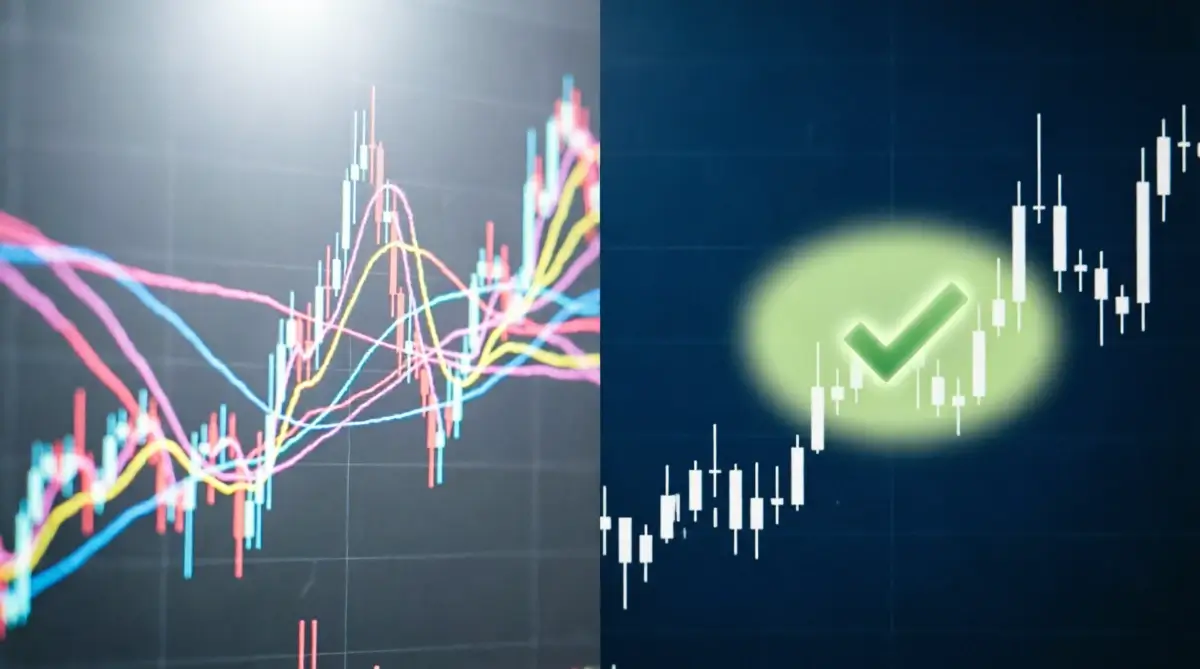
If you are still trying to guess the next candle, the exit from that exhausting cycle begins with refusal to predict ever again. The moment I stopped asking where the market would go and started waiting for my hand‑drawn pattern to appear was the moment trading stopped being an emotional drain and started being a calm, repeatable skill. Prediction gave me the illusion of control while silently destroying my account and my confidence.
Probability reaction built on a sketched diagram, a set of alarms, and a written plan gave me back my consistency. In the following sections, I walk through every stage of that shift, from the breaking point that shattered my faith in forecasts to the boring, beautiful pattern of responding only to what the market actually presents. The rule is simple, but it requires the courage to admit that your opinions add no value and the discipline to let a piece of paper guide your decisions.
The Prediction Mindset That Nearly Destroyed My Trading
I used to believe that thinking the market would go up was enough reason to buy, and that single flawed assumption drove every decision I made for a long stretch. Prediction mindset felt natural because it gave me the illusion of control, yet it repeatedly led to disappointment and a damaged account. This part of my journey is where I trace the damage that forecasting did to both my confidence and my equity curve, laying bare why the shift to probability reaction became non‑negotiable.
The prediction mindset is seductive because it promises certainty in a random environment. Every time I formed an opinion about where price should go, I felt a momentary relief from the discomfort of not knowing. That relief was false, purchased at the cost of future pain when the market inevitably did something different. The more I predicted, the more I had to defend those predictions, and the defense consumed mental energy that should have gone into execution.
The cycle was predictable: form an opinion, enter a trade, watch the market move against me, refuse to accept the loss because my opinion was still correct, hold too long, and finally exit at a much larger loss. The opinion was the chain that kept me locked in losing positions long after the edge had invalidated them. I was not trading the market; I was trading my ego’s need to be right.
The prediction mindset also corrupted my relationship with my trade journal. I would only record the trades that supported my forecasts, conveniently forgetting the ones that did not. The journal became a highlight reel of my supposed genius, rather than an honest record of my decisions. When I finally started recording every trade, the full picture was ugly, and that ugliness was the truth I needed to see.
The illusion of control is a cognitive bias that the market exploits mercilessly. Every time I predicted correctly, my brain released a small dose of dopamine, reinforcing the prediction habit. The occasional correct call was enough to keep the habit alive, even though the net result was negative the market is the perfect environment for intermittent reinforcement, and intermittent reinforcement is the most addictive kind.
The Default Setting: Guessing the Next Move Without a Plan
I would stare at the chart, form a casual opinion about direction, and enter a position based purely on that guess. There was no checklist, no predefined edge, just a gut feeling dressed up as analysis. That default setting kept me trapped in a cycle of random results because a guess is not a trade it is a gamble I built my foundational framework from outcome‑based identity to process‑driven execution.
The gut feeling always felt convincing in the moment. It was supported by a few bars of price action, a news headline, a pattern I thought I recognized. Yet the feeling had no statistical backing. It was a story I told myself, and the market is the worst audience for stories the market responds only to probability, not to narrative.
The absence of a plan meant that every trade was a new experiment with no control group. I could not learn from my mistakes because I had no record of what I was supposed to do. The guess was the strategy, and the strategy was a void.
The absence of a plan also meant that every trade was an isolated event with no connection to the last one. A plan connects trades across time, turning them from random guesses into a coherent experiment. The experiment produces data, and the data reveals the edge.
The default setting is reinforced by the trading industry itself. Charts are presented with indicators that suggest direction, news headlines scream urgency, and social media is filled with confident predictions. The environment is designed to make guessing feel natural. Resisting that environment requires a conscious decision to step outside the noise and build a private system of measurement.
How a Simple Uptrend Call Turned into a Losing Position
Many times I told myself the market should continue higher, only to watch price reverse and take my stop within minutes. The call itself was not the problem; the problem was that I had no probability reaction plan for when the conditions changed. A prediction without a framework for what to do when it fails is just a hope that the market will cooperate for building a self‑concept that survives any market condition.
The reversal was always a surprise because my mind was locked on the forecast. When price moved against me, I did not see a change in market structure; I saw a temporary deviation that would soon correct. The correction never came, and the loss grew. The forecast had blinded me to the reality on the screen.
A probability reaction plan would have specified the exact point where the trade was invalid, and I would have exited without hesitation. But a probability reaction plan requires admitting that the forecast could be wrong, and that admission was incompatible with the prediction mindset.
The lack of a probability reaction plan also meant that I had no criteria for when a trade was working. A trade that moved in my favor by a few ticks felt like confirmation, and I would mentally upgrade the forecast from “likely” to “certain.” The certainty was unwarranted, and it kept me in trades that should have been closed at the first sign of reversal.
A probability reaction plan includes a profit target and a stop loss, both set before the trade is placed. The target and the stop are the boundaries of the experiment. Without boundaries, the experiment has no conclusion, and an unconcluded experiment drains capital indefinitely.
The Emotional Toll of Being Wrong Over and Over Again
Each failed forecast felt like a personal failure, and that accumulated weight made me hesitant to enter even when a genuine opportunity appeared. The prediction mindset tied my self‑worth to being right, and the market had no interest in my emotional state. The cycle of hope and shame drained far more than my account with the long‑term execution mindset of a probability trader.
The shame was cumulative each loss was not just a financial event; it was a judgment on my intelligence. After a series of wrong calls, I began to doubt my ability to read the market at all. That doubt led to paralysis: I would watch valid setups pass without acting, because I could not bear another confirmation of my incompetence.
The paralysis was more damaging than the losses, because it prevented me from taking the trades that could have recovered the drawdown. The prediction mindset was a trap that closed from both sides: wrong calls cost money, and the fear of more wrong calls cost opportunity.
The emotional toll also manifested in my relationships. I was irritable after losing days and euphoric after winning ones, and the people around me learned to read my mood from the market’s performance trading was not just affecting my account; it was affecting my identity as a partner, a parent, and a friend.
The shame of being wrong also prevented me from seeking help. I believed that admitting my struggles would confirm my inadequacy, so I suffered in silence. The isolation deepened the pain, and the pain deepened the isolation breaking the cycle required the courage to admit that I needed a different approach.
The Slow Destruction of Confidence and Trading Capital
Over time, the string of incorrect forecasts chipped away at my belief in my own ability to make sound decisions. I entered fewer valid setups and chased more impulsive ones, trying to recover the capital that my predictions had slowly bled. Prediction was not just a harmless habit; it was the leak that threatened to sink everything.
The capital destruction was gradual, which made it harder to detect. There were no catastrophic blowups just a consistent, grinding decline punctuated by occasional wins that kept the hope alive. The account statement told the truth: a downward slope that no single winning trade could reverse.
The confidence destruction was more subtle I stopped talking about my trading with others. I avoided looking at my account. I traded smaller and smaller sizes, not out of discipline, but out of fear. The prediction mindset had turned me from a hopeful participant into a frightened observer of my own decline.
The slow destruction is harder to detect than a sudden crash a sudden crash forces immediate action; a slow decline lulls you into complacency. I told myself that I was in a “rough patch,” that things would turn around, that my next trade would be the one. The rough patch but the next trade never came.
The capital destruction was compounded by the fees and spreads I paid on every trade. The prediction mindset encouraged overtrading, because each new forecast demanded a new position. The overtrading generated transaction costs that quietly ate away at the account, even when my win rate was decent.
The Breaking Point That Shattered the Illusion of Forecast
There came a moment when I looked at my trading journal and saw that my directional calls were no better than a coin toss, yet they had cost me progress that evidence broke the spell of prediction, and I finally accepted that I could not know where price would go next. The breaking point was not a dramatic meltdown but a calm, humbling admission that my mind’s forecasts added no value.
The journal review was not planned I opened it to look for a specific trade, and I noticed a pattern: the trades where I had expressed a strong directional opinion were disproportionately losers. I started circling those entries, and by the time I finished, the page was covered in red circles. The evidence was undeniable my opinions were not just unhelpful; they were actively destructive.
The calm that followed that realization was unexpected I had expected to feel devastated, yet instead I felt relief. If my opinions were worthless, then I did not need to have them. I could stop trying to predict and start doing something else that something else was probability reaction.
The breaking point was also a moment of grief. I was mourning the loss of the trader I thought I could be the one who could read the market and call the turns. That trader never existed, yet I had to let go of the fantasy before I could embrace the reality.
The grief passed, and what remained was a practical acceptance. I could not predict, and I did not need to predict. I needed a pattern, a plan, and the discipline to follow it. The three elements were within my control, and that was enough.
Accepting That My Opinion of the Next Move Was Worthless
I sat with my trade records and circled every entry where I had acted on a confident belief about direction; the red marks outnumbered the green ones. That visual proof forced me to admit that my opinions were noise, not signal. Accepting worthlessness sounds harsh, yet it was the most liberating realization of my trading life by thinking in odds reshapes every trading decision.
The word “worthless” is not self‑punishment; it is an accurate description of a tool that does not perform its function. My opinions were supposed to predict the market. They failed at that task more often than random chance. Discarding a broken tool is not emotional; it is practical.
The liberation came from the removal of a burden. I no longer had to generate an opinion before every trade. I no longer had to defend that opinion when the market moved against me. I could simply watch, wait, and act according to a plan. The mental energy that had gone into forecasting was suddenly available for observation.
The acceptance of worthlessness is not a one‑time event. It is a practice that must be renewed whenever the old urge to predict resurfaces. The urge never fully disappears; it only weakens with time and discipline. Each time I resist the urge and wait for the pattern instead, I strengthen the probability reaction pathway in my brain.
The journal is the tool that renews the acceptance whenever doubt creeps in, I open the journal and review the trades where I predicted. The red circles are still there, faded but unmistakable. The evidence does not change, and neither does the conclusion.
The acceptance also required me to forgive myself I wasted on prediction the wasted years were not wasted; they were the tuition for the education that produced the probability reaction mindset the tuition was expensive, yet the education was worth it.
Defining the Probability reaction Mindset: Pattern, Plan, and Execution
The probability reaction mindset is the exact opposite of prediction. I no longer ask what the market will do; I wait for my specific pattern to form, and then I execute my predefined plan regardless of any personal opinion. This framework removed the guesswork and turned trading into a sequence of clear, observable steps. I became an executor, not a forecaster, and that shift is what made consistency possible.
The executor does not need to know the future the executor needs to recognize the present. Recognition is a skill that can be practiced; prediction is a gamble that cannot. The shift from gambler to executor is the shift from hope to discipline.
The framework has three components: the pattern, which tells me what to look for; the plan, which tells me what to do when the pattern appears; and the execution, which is the mechanical act of following the plan none of these components requires a forecast. All of them require attention and discipline.
The probability reaction mindset also changed how I read trading books and watched trading videos. I stopped looking for prediction techniques and started looking for pattern definitions and risk management rules. The filter changed what I consumed, and the change in consumption reinforced the new mindset.
The pattern is not a secret it is a simple formation that I have observed hundreds of times. The power is not in the pattern itself but in the discipline to wait for it and to act when it appears the discipline is the edge.
What a Specific Pattern Means in Real‑Time Observation
A specific pattern is a set of visual conditions on the chart that I have defined in advance, not a feeling or a forecast. I watch for it with neutral eyes, and if it appears, I act. The pattern either forms or it does not, and that binary clarity eliminates the needing to know the next move.
The pattern is defined in objective terms: a certain candlestick formation at a certain price level, with volume confirmation that there is no room for interpretation. The definition is written on a piece of paper next to my screen, and I compare the chart to the definition the comparison takes seconds.
The binary nature of the pattern is its greatest strength it prevents the internal negotiation that used to happen when I was predicting. A setup that “almost” meets the criteria is not a setup. The definition is the gatekeeper, and I do not override it.
The pattern must be defined with enough specificity that two independent observers would agree on whether it is present. Ambiguity is the enemy of probability reaction. If the pattern can be interpreted in multiple ways, the interpretation will be influenced by my emotional state, and the probability reaction system collapses back into prediction.
I test the specificity of my pattern by describing it to a friend who does not trade. If they can identify it on a chart after a brief explanation, the pattern is sufficiently clear. If they hesitate or ask clarifying questions, the definition needs refinement.
The Predefined Plan That Replaces Opinion with Action
I wrote down exactly what I would do when the pattern triggered where to enter, where to place my stop, and where to set my target. That plan lives on a piece of paper next to my screen, and I follow it without debate. Opinion has no role when a plan is sitting in plain sight.
The plan is specific it contains the entry price, the stop price, the target price, and the position size. There is no “maybe” in the plan. When the pattern triggers, I execute the plan exactly as written the plan was designed in a state of calm analysis; it is more reliable than any in‑the‑moment decision.
The plan also covers what I do when the pattern absence of action is part of the plan. Waiting is not passive; it is the active discipline of refusing to act without the edge.
The plan also includes a rule for what happens after a loss. I do not immediately look for the next setup. I close the journal for a set period, allowing the emotional response to dissipate before I re‑engage with the plan, and it prevents the revenge trading that used to follow every loss.
The plan is reviewed at the start of every session I read it aloud, reminding myself of the commitments I have made. The reading is a form of mental preparation, a declaration that today I will follow the plan regardless of what the market does.
Trading Without the Need to Know What Happens Next
I now place a trade understanding that the next candle could go anywhere, and that does not bother me because the plan covers every possible outcome. The need to know evaporated the moment I realized the plan did not require a forecast. I react to what price does, not to what I think it might do.
The plan covers every outcome because it specifies the maximum loss on every trade. When the loss is known and accepted in advance, the direction of the next candle becomes irrelevant. I am prepared for both possibilities, and the preparation removes the fear.
The freedom of not needing to know is the freedom to be present. I am not projecting into the future; I am observing the present. The present is where the trade is, and the present is where my attention belongs.
The need to know is rooted in a fear of uncertainty the plan does not eliminate uncertainty; it embraces it. The plan says: “I do not know what will happen, and I have prepared for every possible outcome.” The preparation is the antidote to the fear.
The fear of uncertainty is also the fear of loss the plan addresses this by specifying the maximum loss on every trade. When the maximum loss is known in advance, the fear of an unlimited loss disappears. The loss becomes a known quantity, and known quantities are manageable.
The Freedom of Responding Only to What Price Actually Presents
When I stopped imposing my expectations on the chart and started responding to the price action in front of me, the mental weight of trading lifted. I see a pattern, I execute the plan, and I move on that freedom is the direct result of shifting from anticipation to observation.
The weight that lifted was the weight of pretense. I had been pretending to know, and the pretense was exhausting. Responding requires no pretense. The chart shows what it shows, and I respond accordingly. The simplicity of the transaction is what makes it sustainable.
The freedom also extends beyond the trading session. I no longer carry the stress of open positions into the rest of my day. The alarms handle the watching, and I reclaim the hours that were once lost to anxious monitoring.
The freedom also includes the freedom to be wrong without shame. When I respond to a pattern and the trade loses, the loss is a data point, not a personal failure. The probability reaction was correct; the outcome was unfavorable. The distinction preserves my self‑respect through the inevitable losing streaks.
The freedom extends to the time between trades. I no longer fill the empty hours with market analysis and prediction. I fill them with other pursuits learning, exercise, family. Trading has become a part of my life, not the center of it.
Drawing My Edge on Paper and Setting Alarms for Mechanical Action
The practical transformation happened when I physically drew my edge on a notepad and set alarms at the key levels that mattered. No more staring at screens waiting for something to happen; the alarm told me when price reached my area, and a glance at the chart confirmed whether the pattern had formed. This simple duo of paper and alarm turned probability reaction from a concept into a daily routine.
The hand‑drawn diagram is the reference point of the probability reaction system. It is a fixed standard that does not change with market conditions with emotional states the alarm tells me when to consult the diagram. Together, they replace the constant vigilance that prediction demanded.
The physicality of the diagram is important it is not a digital overlay on the chart; it is a separate piece of paper that I can hold in my hand. The separation reinforces the objectivity of the reference the chart is reality; the diagram is the standard. Comparing the two is a mechanical act, not an interpretive one.
The hand‑drawn diagram is also a tool for teaching when I share my approach with other traders, I show them the diagram before I show them the chart. The diagram communicates the edge more clearly than any verbal explanation.
The alarm is set on a platform that I access from my phone. I do not need to be at my desk to know when price has reached my level. The portability of the alarm frees me from the desk and allows me to live my life while the market does its work.
Translating the Edge into a Hand‑Drawn Diagram for Instant Clarity
I sketched the pattern on paper so that my eyes could check the chart against a fixed reference in seconds. The diagram is not a piece of art; it is a visual checklist that removes any ambiguity from the moment of decision. When the alarm sounds, I look at the sketch and the chart side by side, and I act to kill the ego to let the statistical edge compound.
That captures the essential elements of the pattern: the shape of the candlesticks, the relative position of the highs and lows, the volume signature if relevant the minimalist, contains only what is necessary for identification.
The act of drawing the pattern cements it in memory. I have drawn my edge dozens of times, and each time I reinforce the visual template in my mind the drawing is both a reference and a practice.
The diagram is updated periodically. When I review a block of trades and notice that the pattern has evolved, I adjust the sketch to reflect the current market structure. The diagram is a living document it is only changed outside of trading hours, when I am calm and analytical.
The act of drawing the pen on paper engages a different part of the brain than staring at a screen. The drawing process solidifies the pattern in memory and creates a tactile connection to the edge the edge is not just a concept; it is a sketch that I have made with my own hands.
Why a Simple Pen‑and‑Paper Reference Cuts Through Market Noise
With a physical drawing, I do not get lost in the chatter of indicators or the emotions of the moment. The paper holds the standard, and I merely compare reality to it. That act of comparing is fast, objective, and immune to the fear that usually clouds a trader’s mind.
The market noise is the enemy of clear decision‑making. Indicators conflict, news headlines distract, and emotions amplify every tick. The paper is silent. It does not update with every price change. It simply states the conditions, and the trader either sees them or does not.
The objectivity of the paper is its greatest value it does not care about my recent winning streak and my current drawdown. It does not know the news or the market sentiment. It is a fixed standard in a shifting world, and that fixity is what makes it trustworthy.
The paper reference also serves as a barrier against the influence of other traders. When I see a confident prediction on social media, I can hold up my diagram and ask: “Does this match my pattern?” The answer is almost always no, and the diagram protects me from the contagion of someone else’s forecast.
The paper is also a reminder of the simplicity of the probability reaction approach. In a world of complex algorithms and high‑frequency trading, a hand‑drawn diagram seems almost naive. Yet the simplicity is the strength. The market does not reward complexity; it rewards consistency.
Setting Alarms at Key Zones to Stop the Compulsion to Watch
I place an alarm at the price level where my pattern is likely to complete, and then I step away from the screen entirely. No more idle scanning that invites premature guesses; the alarm is my cue to return this practice has saved me from countless impulsive entries that your trading results do not define your worth.
The compulsion to watch is driven by the fear of missing an opportunity. The alarm removes that fear. I know that if the opportunity appears, the alarm will notify me. There is no need to monitor every tick. The alarm is a trusted assistant that never sleeps and never panics.
Stepping away from the screen is an act of discipline it is a declaration that the trade is managed and that my presence is no longer required the screen becomes a tool, not a prison.
The alarm is set at a level that is derived from the edge’s historical behavior, not from my desire for action. I know, from my journal, the typical price ranges where my pattern completes. The alarm is placed at the midpoint of that range, and I trust the data.
The compulsion to watch is also a compulsion to control by watching every tick, I believed I could influence the outcome. The belief was false, and the alarm shattered it. The alarm does not care about my desire for control; it simply beeps when the condition is met.
Reacting Only When Price Reaches My Area and Forms the Setup
When the alarm triggers, I open the chart and check if the full pattern is present. If it is, I execute the plan; if it is not, I walk away and wait for the next alarm. I do not care about the price action that happened in between I only care about the moment that matches my edge.
The alarm is the invitation and the decision is made by comparing the chart to the diagram. If the chart matches the diagram, the decision is already made: execute the plan. The sequence eliminates the hesitation that used to cost me entries.
Walking away when the pattern is absent is as important as acting when it is present. The discipline to say “not yet” preserves capital for the moment when the answer is “yes.”
The probability reaction at the alarm is a binary event I check the chart, compare it to the diagram, and make a yes‑or‑no decision. The binary nature of the decision eliminates the gray area where prediction thrives. Prediction lives in “maybe.” Probability reaction lives in “yes” or “no.”
The discipline to walk away when the pattern is absent is strengthened by the evidence of the journal the journal shows that forced entries trades taken without the full pattern have a significantly lower expectancy than trades taken with the full pattern the evidence is the motivation to wait.
The Mechanical Pattern That Replaced the Mental Exhaustion of Guessing
What I have now is a consistent pattern: alarm sounds, pattern check, plan execution, journal entry. There is no mental energy spent on forecasting, and the consistency of the routine has made my trading sessions feel almost boring. That boring pattern is the signature of a probability reaction‑based approach.
The pattern is predictable. I know exactly what I will do at each step, and the predictability is calming. The mental energy that was once consumed by anxiety is now available for observation and refinement.
The boring pattern is also sustainable. It does not depend on motivation or willpower. It is a habit, and habits run on autopilot. The autopilot keeps me executing correctly even on days when I feel tired or distracted.
The mechanical pattern also makes it easier to track my performance. Each trade follows the same sequence, so each trade is comparable the comparability allows me to calculate my expectancy with precision, and the precision reinforces the probability reaction mindset.
The pattern is not disrupted by winning streaks or losing streaks. The alarm still sounds, the pattern is still checked, the plan is still executed. The market’s condition does not change the pattern that dependents n the market’s condition.
Why Probability reaction Is Faster, Calmer, and Infinitely More Reliable
The probability reaction mindset outperforms prediction on three dimensions that matter most in trading: speed, emotional consistency, and reliability of outcome. When I react to a pre‑defined setup, there is zero hesitation, and the calm that comes from not guessing allows me to repeat the action without mental fatigue. Because my flawed forecasts are no longer part of the process, the edge can express itself far more cleanly.
Speed is not about rushing; it is about the absence of internal debate. When the pattern appears, I do not ask whether I feel good about the trade whether the news supports it. I execute the plan has already answered every question.
Calmness is the product of certainty. I am certain that the plan was designed correctly, and I am certain that following it is the right action the outcome is uncertain the action is not. Certainty about the action produces calmness regardless of the outcome.
Reliability comes from consistency when every trade is executed the same way, the results reflect the edge, not the trader’s mood. The edge is reliable; the trader’s mood is not probability reaction aligns the trader with the edge.
The probability reaction also improves with practice. The first few times I used the alarm‑diagram‑plan system, I was slow and uncertain. After dozens of repetitions, the sequence became fluid. After hundreds, it became automatic. The automaticity is the goal.
Speed: No Hesitation When the Alarm Sounds and the Pattern Appears
I do not have to think about whether I like the trade where the market might be heading; I just execute the plan I already wrote down. That immediate action prevents the slow second‑guessing that used to cost me the best entries. Speed here is not rushing; it is the absence of internal argument to separate lucky runs from genuine skill over a large sample.
The internal argument used to go like this: “The pattern is there with the overall trend is weak. Maybe wait for more confirmation. what if it runs without me? But what if it reverses?” The argument could last minutes, and by the time it ended, the opportunity was gone. The plan ends the argument before it begins.
The plan is the authority when the alarm sounds and the pattern matches the diagram, the plan says enter. There is no appeal to a higher court. The plan’s authority is absolute, and that absoluteness is what produces speed.
The speed of probability reaction also applies to exits when the trade reaches the profit target or the stop loss, I exit immediately, without negotiation. The exit is part of the plan, and the plan does not allow for hesitation. The speed of the exit preserves the edge’s expectancy.
Hesitation on exits used to cost me more than hesitation on entries. I would watch a winning trade give back its gains, a losing trade deepen its loss, while I debated whether to act the plan ended the debate.
Calmness: The Inner Stillness of Not Having to Be Right
When my only job is to recognize a pattern and follow a plan, I feel no pressure to prove anything. A losing trade does not disturb my consistency because I know the probability reaction was correct even if the outcome was unfavorable that calm is the most valuable by‑product of removing my opinion from the equation.
The pressure to be right was the source of my trading stress. Every trade was a test, and every loss was a failure. The probability reaction mindset replaces the test with a checklist. The checklist does not grade me; it guides me the guidance is calming.
The calmness persists through both wins and losses a winning trade does not inflate my ego, because the win was the result of the plan, not my brilliance. A losing trade does not deflate my self‑worth, because the loss was the result of the plan encountering normal variance the plan absorbs the emotional impact of both outcomes.
The calmness is also a product of trust in the process I trust that the plan was designed correctly, because I have tested it over hundreds of trades. I trust that the pattern will appear with sufficient frequency, because the journal records its historical rate. The trust is evidence‑based, and evidence‑based trust is stable.
The calmness also improves my overall health and the stress of prediction had manifested in poor sleep, tension, and irritability. The calmness of probability reaction has alleviated those symptoms trading is no longer a health risk.
Removing My Flawed Forecasts from the Equation
The core reason probability reaction works is brutally simple: it takes my unreliable, emotion‑driven predictions out of the trading process entirely. Instead of being the weakest link in the chain, I become a neutral operator who simply connects the market’s signal to the plan’s action. That removal of self is what allows the edge to function as intended.
The self was the problem my fears, my hopes, my recent wins and losses these colored every prediction I made. The predictions were not market analysis; they were psychological projections. Removing the predictions removed the projections, and what remained was a clean signal path from the market to the plan.
The neutral operator is an ideal that I strive toward I am not always neutral; emotions still arise. Yet the plan gives me a place to return to when emotions threaten to take over. The plan is the neutral ground, and I can always step back onto it.
Removing forecasts also removed the need to defend them. I used to spend hours arguing about market direction, trying to prove that my analysis was correct. The arguments were draining and pointless. The probability reaction mindset has no need for argument; it only needs evidence.
The evidence is in the journal when someone challenges my approach, I can show them the adherence scores and the expectancy calculation. The evidence speaks for itself.
How My Personal Biases Turned Every Forecast into a Trap
My predictions were never neutral; they were colored by the last trade, my mood, and a desperate desire to recover losses. Those biases meant I saw patterns that were not there and ignored the ones that were. Now the pattern and the plan act as an external filter that how to build like a casino mindset for emotional resilience in trading.
The bias after a loss was the most dangerous I would see bullish patterns everywhere, because I needed the market to go up to recover my money. The need created the pattern, not the other way around. The external filter of the diagram prevents this: either the pattern matches the sketch, it does not, regardless of my account balance.
The bias after a win was equally dangerous I would see patterns that confirmed my brilliance, and I would enter trades that were not part of my edge. The external filter does not care about my recent success. It only cares about the present chart.
The biases were not just psychological; they were also social. I was influenced by the opinions of traders I respected, and I would adopt their forecasts as my own. The external filter of the diagram and the plan removes social influence as well. The only question is whether the pattern matches the sketch, not what someone else thinks.
The removal of forecasts also removed the need to be right in conversations about the market. I no longer debate market direction, because my opinion is irrelevant to my trading the silence that replaced the debates is peaceful.
Becoming a Trader Who Responds, Not One Who Anticipates
I now move through each session as a responder: I wait for the market to show its hand, and then I play mine according to a fixed set of rules. There is no anticipation, no mental projection, and no attachment to a specific outcome. This new identity has reshaped how I experience every trading day, turning the chart into a mirror that reflects my discipline rather than my predictions.
The responder identity is humble it acknowledges that the market leads and I follow. The old identity, the predictor, was arrogant. It believed I could lead the market. The market does not follow anyone, and the predictor was constantly disappointed. The responder is never disappointed, because the responder has no expectations.
The mirror is precise the chart shows me whether I followed my plan. A clean execution is reflected in a calm equity curve. A deviation is reflected in a jagged one. The chart is not a judgment; it is feedback the responder uses the feedback to improve.
The responder identity also changes how I handle market news. A surprise announcement that spikes volatility is not a threat; it is a test of the plan. The plan includes rules for high‑volatility conditions, and I follow those rules.
The responder does not celebrate wins or mourn losses the responder records both and moves on. The emotional flatness is not a personality trait; it is a trained response, and it is available to anyone who commits to the probability reaction system.
The Daily Practice of Waiting for the Pattern Without Expectation
I begin each session with a clear intention to wait, watch, and do nothing until the market presents my edge. There is no feeling of missing out, because I know that forcing an entry is a prediction in disguise. The act of patient waiting is itself the first probability reaction of a disciplined trader for building a belief system connected in probability.
The intention is stated before the session. I write it on a note: “Today I wait. I respond only to what the market shows me.” The note is a contract with myself, and I place it beside the screen. When the urge to predict arises, the note reminds me of my commitment.
The absence of expectation is the absence of demand. I do not demand that the market provide a setup today. I do not demand that the market move in a certain direction. I accept whatever the market offers, and I respond accordingly.
The daily practice also includes a review of the previous session’s trades. I check my adherence and note any deviations. The review is brief no more than ten minutes and it closes the previous session before the next one begins.
The practice of waiting has taught me that the market is generous with opportunities over time. There is always another setup, another day, another week the fear of missing out is based on a scarcity mindset, and the scarcity is an illusion.
Letting the Market Lead While I Follow with a Fixed Set of Rules
I no longer try to lead the market by guessing the next wave; I let it move freely and I follow with my plan only when it comes to my designated area. This followership feels counterintuitive at first, yet it places me on the right side of probability far more often than my old leading approach ever did.
Leading the market was exhausting because it required constant effort with no guarantee of reward. Following the market requires patience, not effort. The patience is learned; it took months of practice to sit through trending days without entering a single trade.
The rules are the leash that keeps me from chasing. When the market runs without me, the rules say “stay.” When the market reverses sharply, the rules say “stay.” The rules only say “act” when the pattern is present, and that discipline is what keeps the account safe.
Following the market also means accepting that some moves are not for me. A strong trend that does not trigger my pattern is not a missed opportunity; it is a market condition that falls outside my edge is a filter, and the filter excludes as much as it includes.
The rules are not restrictive; they are liberating. They free me from the burden of decision‑making in real time. The decisions were made when I wrote the plan all that remains is execution.
The Power of Indifference to What the Market Might Do Next
Indifference does not mean I do not care about my performance; it means I do not care which way the next candle breaks. That emotional distance protects me from the pain of unexpected moves and allows me to execute the plan whether the trade is a winner or a loser as an intellectual humility strengthens your trading process.
The pain of unexpected moves was the pain of shattered expectations. When I had a prediction, every tick against me was a personal insult. Without a prediction, a tick against me is just a tick. It carries no emotional charge the indifference is the shield that protects my mental state.
Indifference is cultivated through repetition. The more trades I take where I follow the plan and accept the outcome, the more my brain learns that the outcome is not personal. The learning is slow, yet it is permanent.
Indifference also reduces the temptation to move my stop. When I am indifferent to the outcome, I do not care if the trade is stopped out the stop is part of the plan, and I leave it in place. Moving the stop is an act of prediction a bet that the market will reverse and I no longer make that bet.
The indifference is not coldness; it is focus. I am focused on the process, not on the result. The process is always available; the result is always uncertain focusing on the available is practical.
How Reacting Transformed the Shape of My Equity Curve
Since the shift, my equity curve has lost the violent spikes and drawn‑out drawdowns that used to define it. The smooth slope that remains is the visual proof that probability reaction eliminates the destructive mistakes that prediction repeatedly introduced.
The spikes were the result of oversized bets after a winning streak a prediction that the streak would continue. The drawdowns were the result of refusing to accept losses a prediction that the market would reverse removing the predictions removed the spikes and the drawdowns.
The smooth slope is not dramatic it does not make for an exciting story. Yet it is sustainable, and sustainability is the goal of a trading career. The smooth slope is the signature of a responder.
The smooth equity curve also makes it easier to manage my emotions during drawdowns. A jagged curve with deep drawdowns triggers panic; a smooth curve with shallow pullbacks triggers patience. The curve itself is a source of emotional stability.
The curve also provides a visual record of my progress when I compare my curve from a year ago to my curve today, the improvement is visible the improvement is gradual, yet it is undeniable.
The Identity Shift That Cements Long‑Term Consistency
I no longer call myself a trader with a good feel for the market; I call myself someone who responds to predefined conditions with a written plan. That self‑description keeps me humble and process‑oriented, and it is the foundation of every consistent stretch I have enjoyed.
The self‑description is a deliberate choice. The old description “a trader with a good feel” was a claim to predictive ability. The new description” someone who responds to conditions” is a statement of discipline the new description is honest, and the honesty reinforces the identity.
The identity shift is the final step it is not enough to change the behavior; the self‑concept must change as well. When I see myself as a responder, prediction becomes unthinkable. It is simply not something that a responder does.
The identity shift also changes how I respond to compliments and criticism. When someone praises a winning trade, I redirect the praise to the plan. When someone criticizes a losing trade, I evaluate the criticism against the plan. The plan is the standard, not my ego.
The identity of a responder is not glamorous it does not make for exciting stories at parties with sustainability is the foundation of a long trading career.
The Subtle Shift That Changed Everything
The move from prediction to probability reaction was not a dramatic overhaul; it was a subtle reorientation of my attention from what might happen to what is happening. Yet that subtle shift changed everything my stress level, my trade frequency, and my overall profitability. It is the quietest transformation I have ever made, and the most powerful.
The subtlety is important there was no single moment of revelation, no dramatic event. There was a gradual turning of attention, like a slow pan of a camera from a distant horizon to the ground beneath my feet. The horizon was always uncertain; the ground was always solid the probability reaction mindset is the ground.
The change in stress level was the first thing I noticed. I ended trading sessions with energy to spare, rather than collapsing in exhaustion. The change in trade frequency followed: I took fewer trades, yet the trades I took were of higher quality. The profitability came last, as a natural consequence of the first two changes.
The subtle shift is in attention is the most valuable resource a trader has. The prediction mindset directs attention to the future, which is unknowable. The probability reaction mindset directs attention to the present, which is observable. The observable is actionable; the unknowable is not.
The shift in attention also changed how I experience time when I was predicting, time dragged between trades, and I filled it with anxiety. Now, time flows naturally, and I fill it with other activities. Trading is no longer the sole focus of my existence.
Why a Simple Change in Mental Posture Unlocks the Edge’s Full Potential
When I stopped reaching into the future and started placing my focus on the present chart, the edge that had always been there was suddenly free to work. The only thing that had been holding it back was my insistence on guessing now I react, and apply the randomness to build a quantitative edge.
The edge was always present the patterns I trade now are the same patterns I was trying to predict the difference is not in the patterns; it is in my relationship to them. I used to try to force them to appear; now I wait for them to appear. The waiting is the key.
The edge does not need my help. It needs my non‑interference. Every prediction was an interference, a deviation from the plan that degraded the edge’s performance. Removing the predictions was like removing a governor from an engine. The engine was always powerful; the governor was holding it back.
The mental posture is maintained through daily practice every session, I remind myself that my job is to respond, not to predict. The reminder is a sentence written on a card that sits beside my screen the card is my reminder.
The simplicity of the shift is deceptive it is easy to understand and difficult to implement. The difficulty is not in the concept but in the unlearning. Prediction is a deeply ingrained habit, and habits do not break easily they are broken through repetition the repetition of waiting, watching, and reacting.
The unlearning process is supported by the evidence of the journal. Each clean execution is a promise for the probability reaction mindset. Each deviation is a signal that supports the prediction mindset. Over time the promises accumulate, and the probability reaction mindset wins.