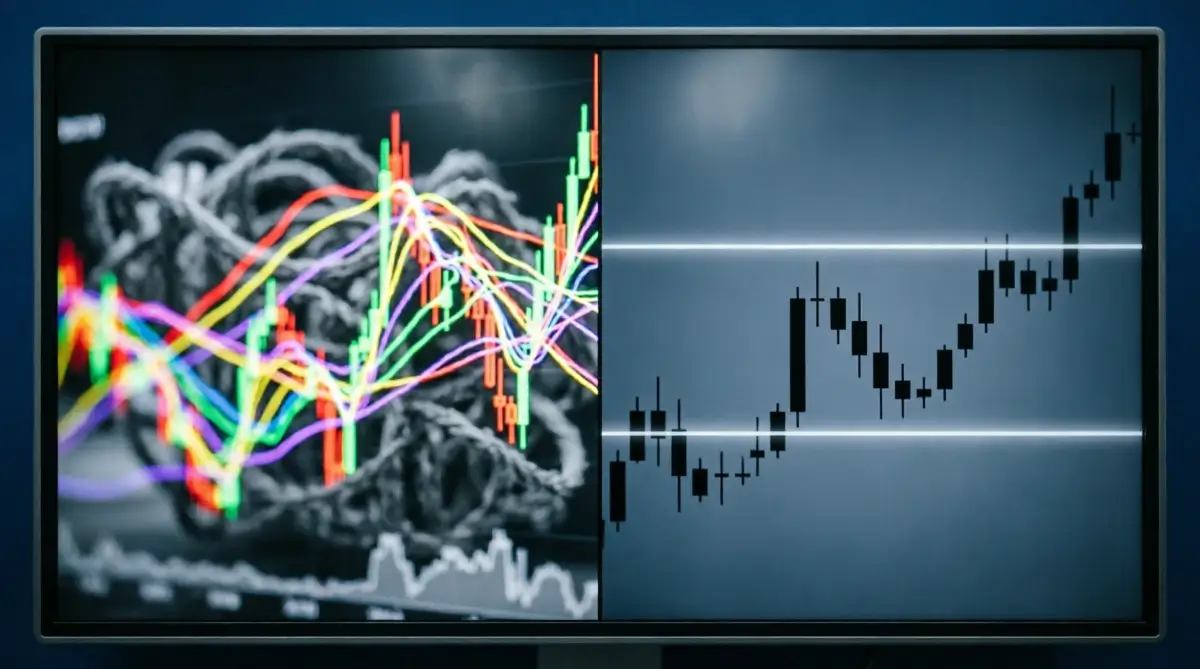
The market taught me a lesson I was too proud to learn from any book: no amount of knowledge or intelligence can bend probability. I spent a lot of time for collecting courses, layering indicators, and trying to outthink every other participant, only to watch the market humble me repeatedly. Intellectual humility begins where the illusion of predictive intelligence ends.
Admitting I cannot forecast the next candle is not weakness it is the foundation of a trading mind that works with odds instead of against them. The shift from arrogant certainty to humble probability changed everything: my consistency, my emotional state, and my equity curve. In the following pages, I will walk you through every part of the transformation, from the farmer’s field to the trade journal, so you can stop trying to be the smartest person watching the chart and start being the most disciplined.
The Trap of Trying to Outsmart the Market with Knowledge
I spent a long stretch convinced that stacking market courses and loading complex indicators onto my screen would give me an advantage over every other participant. The market proved repeatedly that being clever or well‑read does not bend probability. Intellectual humility begins where the illusion of predictive intelligence ends, and it was the only path that restored my consistency. The present section dismantles the false pride of trying to outsmart price and sets the foundation for a mind that works with odds instead of against them.
The trap is seductive because knowledge feels like power each new course, each new indicator, each new book gave me a temporary sensation of control. I believed I was building an arsenal that would finally crack the market’s code the market does not care about my library.
It distributes outcomes according to probability, not according to how much I have studied. The accumulation of knowledge without the humility to accept randomness to avoid frustration and how to build a process‑based identity beyond outcomes explains the identity that outperforms any technical knowledge.
The cycle of knowledge‑seeking is endless there is always another course, another expert, another indicator promising the answer. I chased that promise for years, and each chase ended in disappointment. The disappointment was not the market’s fault; it was the predictable result of seeking certainty in a random system. Intellectual humility is the decision to stop seeking what does not exist and start working with what does.
How Market Courses and Complex Indicators Gave Me a False Sense of Control
I absorbed every piece of technical material I could find, mistaking collected information the market did not care about any of it, and each loss chipped away at the arrogance that self‑study had built the hard realization was that no amount of chart‑based learning can substitute for accepting the random nature of price movement.
The false sense of control came from a simple equation: more knowledge equals more certainty. The equation is false. Knowledge of support levels, moving averages, and candlestick patterns provides context, not prediction. I could know everything about a chart and still lose the next trade. The market’s randomness does not yield to expertise accepting that was the first crack in my intellectual armor.
The courses and indicators also created a dependency I outsourced my decision‑making to external tools, believing they could see what I could not. When the tools failed, I blamed them, not my reliance on them. True independence came when I removed the tools and faced the chart alone. The fear of being alone with the chart was the fear of being responsible for my own decisions embracing that responsibility was an act of humility.
Why the Market Is Always Smarter Than Any Single Participant
No individual can process the sheer volume of information driving each tick, and the collective action of all players makes the market a distribution far larger than my mind. Humility comes from acknowledging that I am a tiny node in a vast probabilistic system. That acknowledgment is not defeat; it is the starting point for a sustainable trading mind.
The market represents the decisions of millions of participants, each acting on different information, different timeframes, and different goals. My single analysis, however thorough, is a drop in an ocean. The price that prints is the net result of all those actions, and it carries a wisdom that no individual can match. Intellectual humility is the recognition of that collective intelligence.
The collective intelligence of the market means that any single prediction is likely to be wrong. Not because the predictor is unintelligent because the system is too complex for any individual to model perfectly. Accepting that complexity is not an excuse for laziness; it is a reason to focus on what can be controlled risk management, entry rules, and exit discipline rather than on what cannot.
The Endless Search for the Perfect Indicator That Never Delivered
I layered indicator upon indicator, hoping the right mix would reveal a certain future. The result was confusion, hesitation, and a chart so cluttered it hid the simple patterns I now rely on. Stripping those tools away was an act of intellectual surrender that made room for a genuine probabilistic approach.
Each new indicator promised clarity and delivered noise the screen became a mosaic of conflicting signals, and I spent more time interpreting the indicators than observing price itself. When I finally removed them, the chart was bare, and I was forced to confront the market directly The direct confrontation was humbling, yet it was also the beginning of clarity.
The search for the perfect indicator is a search for a shortcut the shortcut does not exist the only path to consistency is through discipline, patience, and the acceptance of uncertainty. Intellectual humility is the willingness to walk that path without the crutch of false promises.
Letting Go of the Need to Predict the Next Candle
The pivot happened when I stopped demanding to know the next move and instead accepted that I could not predict it. That acceptance felt like a loss of power, yet in truth, it freed me from the exhausting chase for certainty. Now I only need a statistical advantage, not a forecast.
Prediction is a burden it requires me to be right, and being right is impossible over a large sample. Letting go of prediction meant letting go of the need to be right, and that release was the most liberating act of my trading life. I no longer judge myself by the accuracy of my forecasts; I judge myself by the quality of my execution.
The release also changed my relationship with losses a loss after a failed prediction felt like a personal failure. A loss within a probabilistic edge feels like a routine cost. The difference in emotional impact is enormous, and it is the direct result of intellectual humility.
Why Admitting You Cannot Predict Is Strength, Not Failure
Many people see the admission of unpredictability as a weakness, yet I have found it to be the strongest position a trader can hold. When I stopped pretending I knew what would happen, I stopped feeling the sting of being wrong and began to see losses as a natural part of the edge. The mental shift removed the shame that used to paralyze me, allowing me to execute with a clear and strong intellectual humility is the courage to stand in uncertainty and still act, not because I am certain because the odds are in my favor.
The admission of not knowing is a declaration of independence. Independence from the need for validation, from the fear of being wrong, from the exhausting performance of expertise. When I say “I do not know,” I am not confessing incompetence; I am stating a fact and freeing myself to act within the bounds of what I can control.
The strength in admitting uncertainty is that it aligns my actions with reality. The reality is that the market is unpredictable. Fighting that reality is weak; accepting it is strong. The strong trader builds a system that works within unpredictability; the weak trader demands predictability and is broken by its absence.
The First Time I Said “I Do Not Know What Will Happen Next”
Saying those words aloud, even to myself, felt like dropping a heavy pack I had carried for a long while. The sky did not fall, and the market did not punish me for my honesty. Instead, I felt a surge of clarity that allowed me to place a trade with no emotional weight attached.
The heavy pack was the weight of pretense I had been pretending to know, and the pretense was exhausting. Releasing it created space for genuine engagement with the market. The trade I placed after that admission was the first trade I took as a truly humble participant.
The admission also changed how I spoke about trading with others. Instead of making bold predictions, I began to describe my edge in probabilistic terms: “The setup has historically reached its target before its stop about a third of the time.” The honesty was refreshing, and it attracted conversations with traders who shared the same humble approach.
How the Need to Be Right Creates a Fragile Trading Psychology
I used to tie my sense of self to calling the next move, and every losing trade felt like a personal insult. The need for certainty built a brittle mental state that cracked under normal variance. Humility replaced that brittleness with a flexible mind that can absorb losses without breaking.
Brittleness comes from rigidity a rigid belief that the market must behave a certain way shatters when the market does what it always does something unexpected. A flexible mind, grounded in humility, bends with the unexpected and returns to its original shape. Flexibility is the psychological prerequisite for survival in a random environment that a neutral self‑identity survives drawdowns.
The need to be right also distorts risk perception a trader who needs to be right holds losing positions too long, hoping the market will prove them correct. The humble trader knows they could be wrong and cuts the loss quickly. The humble trader’s risk management is superior because it is not clouded by ego.
The Relief of No Longer Having to Be the Smartest Person in the Room
Chasing the title of market genius is exhausting because the market can humble anyone in a single session. I now rest in the understanding that I do not need to outthink the entire market; I only need to execute a proven edge with discipline. The relief freed up energy I now spend on reviewing my trade journal.
The title of genius is a trap it demands constant confirmation, and the market provides none. The title of executor is a role. It demands consistency, and consistency is within my control. Shifting from the trap to the role was a profound relief.
The relief also extended to my personal life I stopped carrying the stress of needing to be right into my relationships. I became a calmer, more present person because my identity was no longer tied to my trading performance. Intellectual humility improved not just my trading my life.
Why Predictions Are Not Required for Consistent Profitability
A solid expectancy does not ask me to forecast where price will close. It asks me to apply a predefined set of rules across enough trades to let the math play out. I stopped predicting and started managing risk and reward, and that is when my equity curve began to stabilize.
Prediction focuses on the outcome of a single trade expectancy focuses on the outcome of a series. The single trade is unknowable; the series is statistically predictable. Shifting focus from the unknowable to the predictable is the essence of probabilistic trading.
The shift also changed how I set goals instead of aiming for a certain win rate, I aimed for a certain number of clean executions. The goal was achievable and measurable. The equity curve followed the execution quality, and the predictions became irrelevant.
What the Farmers in My Village Taught Me About Humility and Probability
In the village where I grew up, the farmers who survived harsh seasons were not the ones who believed they could control the weather. They were the ones who planted the right seeds at the right time and always prepared for drought trading follows this rule: I build my edge with humility, protect it with a stop loss, and let nature take its course the simple, grounded lesson from observing the land taught me more about probability than any trading manual ever could.
The farmers lived probability without ever calculating it they knew the rains might not come, so they stored grain. They knew pests might attack, so they built fences. Their wisdom was not intellectual; it was experiential. Trading, stripped of its screens and charts prepare for the worst, execute the plan, and accept the outcome.
The farmer’s life is a model of intellectual humility no farmer claims to control the weather. No farmer demands that every seed sprout. The farmer works with nature, not against it. The trader who adopts this posture works with probability, not against it. The results, over time, are a harvest that no amount of forced effort could produce.
The Farmers Who Survived Were Not the Ones Who Claimed to Control the Weather
I watched proud farmers gamble on a perfect season and lose everything when the rains failed, while the humble ones had stored grain and diversified their planting. The parallel to trading is direct: the trader who bets everything on a single forecast risks ruin, while the probabilistic trader stays solvent by preparing for all outcomes.
The proud farmer planted a single crop, confident in his prediction of favorable weather. The humble farmer planted multiple crops, hedged with stored reserves, and accepted that nature was unpredictable. The proud farmer occasionally had a spectacular season; the humble farmer survived every season. Trading is a game of survival, not of spectacular seasons.
The lesson of the proud farmer is a cautionary tale spectacular success built on a single correct prediction is fragile. The next prediction may be wrong, and the fall from spectacular is devastating. The humble farmer’s consistent, unspectacular approach builds a foundation that endures. The trader who emulates the humble farmer builds a career; the trader who emulates the proud farmer builds a story.
Planting the Right Seeds at the Right Time Without Demanding a Harvest
A farmer does not yell at the sky when a seed does not sprout; he plants another row and tends the soil. I treat each trade entry the way putting the right conditions in place, then stepping back to let the distribution unfold the harvest is not in my hands the planting is.
The farmer’s patience is instructive he does not dig up the seed to check if it is growing. He plants, waters, and waits. I enter a trade, set my stop and target, and wait. The outcome is not my responsibility; the entry quality is. Detaching from the harvest allows me to focus entirely on the planting.
The act of planting without demanding a harvest is an act of faith in the process the faith is not blind; it is based on seasons of evidence. The farmer knows, from years of experience, that most seeds will grow if the conditions are right. The trader knows, from hundreds of trades, that the edge will produce a positive result if the rules are followed. The evidence supports the faith, and the faith supports the patience.
Preparing for Drought as a Trading Risk Management Rule
Every farmer who lasted decades had a plan for the dry months, storing enough to survive until the next planting season. I keep my risk per trade small and my overall exposure limited so that a prolonged losing streak never threatens my ability to keep trading. Preparing for the worst case is not pessimism; it is probabilistic wisdom.
The drought plan is not a prediction of drought; it is an acknowledgment that drought is possible. My risk management is not a prediction of loss; it is an acknowledgment that loss is certain over a large sample. Preparing for certainty is not pessimism; it is prudence with the execution mindset of a probabilistic trader.
The drought plan also includes a recovery strategy the farmer knows how long his stored grain will last and how quickly he can replant when the rains return. I know my maximum drawdown and my expected recovery time. The knowledge removes the fear of the unknown the drought is a known risk, planned for and survivable.
Letting Nature Take Its Course While Protecting the Crop
A farmer puts up a fence around the field and then lets the sun and rain do their work my stop loss is that fence, and once it is set, I let the market do what it does without interference. The blend of protection and surrender is the core of trading with intellectual humility.
The fence defines the boundary of acceptable loss within the fence, the crop grows freely. Outside the fence, the field is protected. My stop loss defines the boundary of acceptable loss. Within the stop, the trade runs freely. Outside the stop, the account is protected the fence is the expression of humility: it admits that some outcomes are unacceptable and must be prevented.
The farmer does not pace along the fence, worrying whether it will hold. He builds it well and trusts it. The trader sets a stop based on the edge’s logic and trusts it. Interfering with the fence moving the stop, removing it, widening it is an act of arrogance. It says: “I know better than the plan.” The humble trader leaves the fence alone and lets the market do what it does.
My Edge Does Not Require Me to Be Smart, Only Consistent
I used to believe that a high intelligence was a prerequisite for trading success, yet the market taught me otherwise. My edge does not depend on clever insights or complex analysis; it depends on my ability to execute the simple rules day after day without deviation. Consistency is the true equalizer, and it is available to anyone willing to put in the repetitions. Intellectual humility allowed me to stop trying to impress the market and start simply following the plan.
The myth of the brilliant trader is pervasive books celebrate the genius who made a fortune on a single call. The reality is that most consistent profits come from traders who execute a simple edge with robotic discipline. Brilliance is entertaining; consistency is profitable. Humility is choosing consistency over brilliance.
The choice between brilliance and consistency is not neutral. Brilliance seeks the spotlight; consistency works brilliance takes risks; consistency manages them. The market rewards the risk‑managed consistency over the flashy, risk‑seeking brilliance. Intellectual humility is the recognition of a path that leads to sustainable trading.
Why Cleverness Often Destroys a Trading Edge
I have watched myself take a valid setup and ruin it by adding a clever adjustment a tighter stop, a later exit based on a sudden flash of inspiration. Those adjustments almost always turned a positive expectancy trade into a loser. The edge works when I stay out of its way, and cleverness is just a polite word for interference.
Cleverness is the ego’s attempt to improve on a proven plan the plan was designed in a state of calm analysis; the clever adjustment is made in the heat of the moment. The calm analysis is almost always superior. Staying out of the edge’s way requires humility: the admission that my in‑the‑moment judgment is less reliable than my pre‑planned rules.
The desire to be clever is a desire for recognition the clever adjustment, if it works, earns a feeling of genius. The humble executor does not seek that feeling. The humble executor seeks the satisfaction of a plan followed the satisfaction is quieter it compounds the feeling of genius fades; the satisfaction of discipline endures.
The Power of Simple Rules Repeated Over Hundreds of Trades
A straightforward entry condition, a fixed risk amount, and a consistent target sound unimpressive, yet they compound into a reliable equity curve when applied without exception. The market rewards repetition, not innovation. I now spend my energy on becoming a better executor, not a more creative one.
Simplicity scales a complex rule set is fragile; it breaks under the pressure of real‑time execution. A simple rule set is robust; it survives the chaos of live markets. The farmer does not invent a new planting technique each season; he perfects the technique he knows the trader perfects the simple edge through repetition and thinking in odds reshapes every trading decision.
The power of simple rules is that they can be followed under stress. When the market is chaotic and emotions are high, a simple rule is a lifeline. A complex rule is a puzzle that cannot be solved in the moment. The humble trader chooses simplicity because they know their own limitations. The choice is an act of self‑awareness and humility.
Planting My Edge with Humility and Letting Nature Take Its Course
I approach each trading day like a farmer walking his field: I check the conditions, follow the calendar, and trust the work I put in will yield results over the full season. I do not demand today’s price action confirm my plan; I only ask that I follow it. The humble posture allows me to accept both winning and losing streaks without emotional whiplash, because I know the edge is working on a time scale far larger than a single session.
The farmer’s daily walk is a practice of observation, not of demand. He checks the soil, the weather, the crop’s progress. He does not yell at the plants to grow faster. I check my charts, my edge conditions, my risk parameters. I do not yell at the market to move in my direction the observation is the work; the outcome is the result.
The daily walk also teaches patience the farmer sees the crops growing slowly over months the trader sees the equity curve growing slowly, over dozens and hundreds of trades. The slow pace is not a problem; it is the natural rhythm of the process. Intellectual humility is the willingness to accept the slow pace and to resist the urge to accelerate it artificially.
The Daily Practice of Checking Conditions Without Forcing an Outcome
Before each session, I review the chart for my predefined setup, and if it is not present, I walk away. The simple act of not forcing a trade is a direct expression of intellectual humility acknowledging the market owes me nothing and my job is to respond, not to dictate.
Walking away is a skill the urge to trade, to be in the game, to make something happen, is powerful. The humble trader recognizes the urge and lets it pass. The absence of a setup is not a failure the information is waiting is an active discipline.
The discipline of waiting is strengthened by the evidence of the journal. When I review my trades and see that forced entries consistently underperform, the urge to force weakens. The evidence teaches the lesson more effectively than any intention. The humble trader learns from the evidence and adjusts the behavior.
Trusting the Edge to Work Over the Full Season, Not the Single Day
Just as a farmer cannot judge his harvest by the first week of growth, I cannot judge my edge by the results of a single session. I now review my performance in blocks of 50 or more trades, which reveals the true expectancy the seasonal view keeps me consistent when the daily numbers wobble.
The seasonal view is a perspective shift. A single day is noise; a season is signal. The farmer knows a cold week does not mean the crop is lost. The trader knows a losing week does not mean the edge is broken. Patience is the bridge between noise and signal with the freedom of trading without needing certainty.
The seasonal view also changes how I respond to winning streaks. A winning week is as noisy as a losing week. The humble trader does not increase size after a hot streak, because the streak is just variance. The seasonal view flattens the emotional response to both wins and losses, creating a stable platform for execution.
How a Stop Loss Protects the Crop and the Trader
A stop loss is the fence that keeps a single bad trade from trampling the entire account. I place it upon entry, and I never move it wider, because moving the fence after a storm does not save the crop the protection is a non‑negotiable part of my probabilistic method.
The fence is set before the storm, not during it. Moving the fence during a storm is an act of panic, not of wisdom. My stop loss is set before the trade, based on the edge’s logic, not on my emotional state. The discipline to leave the fence in place is the discipline of humility.
The stop loss is also an admission that I could be wrong. Every trade carries that admission. The humble trader makes the admission willingly and builds the protection around it. The arrogant trader refuses the admission and pays the price when the market moves against them.
Intellectual Humility as the Path to Working with Probability, Not Against It
Intellectual humility does not mean I am weak or unskilled; it means I am finally wise enough to align myself with the mathematical reality of the market. Instead of fighting the random nature of price, I work within it, using a verified edge that accounts for variance. The shift from adversary to participant is what allows me to stay in the game long enough for the edge to compound.
Working with probability is like swimming with a current rather than against it. Fighting the current exhausts and drowns. Working with the current allows progress with less effort. The market’s randomness is the current the edge is the stroke the humility is accepting the current and swimming with it.
The adversary posture is exhausting because it demands that the market conform to my will. The participant posture is sustainable because it accepts the market as it is. The shift from adversary to participant is the shift from arrogance to humility. It is the shift that makes long‑term trading possible.
Why Fighting the Market’s Randomness Leads to Burnout
I tried to impose my will on price, and every failed attempt drained more of my confidence. The moment I accepted randomness is not my enemy but the very condition that creates opportunity, the fight ended. I stopped burning energy on prediction and redirected it toward execution.
Burnout comes from effort without result fighting randomness is effort without result because randomness cannot be defeated. Accepting randomness is not effort; it is alignment. Alignment conserves energy. The conserved energy is available for the work that produces results: execution, review, improvement.
The energy conserved by ending the fight is substantial before the shift, I ended each trading day drained, regardless of the P&L. After the shift, I end each day with energy to spare. The energy is available for my family, my health, and my personal growth. Intellectual humility improved not just my trading but my quality of life.
Accepting That I Cannot Beat Probability, Only Use It
The market’s distribution cannot be defeated; it can only be understood and placed into a structure that tilts the odds in my favor. The understanding is liberating because it removes the impossible goal of perfection I now aim to be a skilled user of probability, not a conqueror of it.
The goal of perfection is a goal of certainty is unavailable in a random system. The goal of skill is available. Skill is the ability to apply a proven edge consistently. The skilled user of probability does not seek perfection; they seek consistency. Consistency is achievable; perfection is not.
Accepting the limits of my control is an act of intellectual maturity. I control my entries, my risk, my exits, and my journal. I do not control the market’s direction, the volatility, the sequence of outcomes. Focusing on the controllable and releasing the uncontrollable is the essence of probabilistic living.
How Humility Keeps Me from Overleveraging After a Winning Streak
After a run of favorable trades, the old me would increase size and blow up. Now I recognize that a streak is just variance swinging in my direction, and I keep my risk unit exactly the same. Intellectual humility acts as a brake on the ego, preventing me from turning a statistical uptick into a disaster.
The winning streak is the ego’s favorite moment it whispers that the streak is evidence of skill, that the good times will continue, that more risk is justified. The humble trader recognizes the whisper and ignores it. The humble trader knows that the streak is temporary and that the rules apply regardless of recent outcomes that kills the ego to let the statistical edge work.
The discipline to maintain constant risk during winning streaks is as important as the discipline to maintain it during losing streaks. Both disciplines require humility: the admission that I am not special, that variance explains both streaks, and that the edge’s expectancy has not changed.
The Calm State That Comes from Accepting the Full Distribution of Outcomes
When I fully expect that a certain percentage of my trades will fail, a losing session no longer throws me into distress. I am prepared for the full range of what my edge can produce, and that preparedness creates a deep steadiness. That calm is the direct product of working with probability, not against it.
The calm is not a passive acceptance of whatever happens it is an active readiness for every possible outcome. When every outcome is anticipated, none can shock. The shock of unexpected loss is replaced by the calm of expected variance. The calm is the reward for preparation.
The calm also improves decision‑making a calm mind processes information more accurately and acts more deliberately. The calm trader sees setups that the anxious trader misses and executes them without hesitation the calm is not just a pleasant state; it is a competitive advantage.
The Strength Found in Admitting You Do Not Need to Be the Smartest Trader
There is genuine strength in saying, “I do not need to be the smartest person watching this chart.” That admission frees me from the burden of performing, and it opens the door to a trading practice built on repeatable actions rather than flashes of insight the strongest traders I have observed are the ones who have simplified their approach down to a few humble rules and then stick to them without deviation.
The admission is a declaration of independence from the performance of expertise. I am not on stage. The market is not an audience. My only job is to execute, not to impress. The freedom of that admission is profound. It allows me to make mistakes without shame and to learn from them openly.
The strongest traders are not the loudest they are the quietest. They do not debate market direction on forums to boast their wins on social media. They execute their edge, record their results, and move on. Their strength is in their consistency, not in their visibility. Intellectual humility is the foundation of that strength.
Letting Go of the Ego That Demanded I Prove My Intelligence
I used to enter trades to demonstrate how well I could analyze, and the outcome mattered less than the feeling of being right. That ego‑driven motivation led to poor risk decisions and a heavy emotional toll. I now enter trades because the edge conditions are met, and my self‑worth is no longer riding on the result.
The ego’s demand for proof is insatiable each correct call only feeds the need for the next. The cycle is exhausting and unsustainable. Letting go of the need to prove intelligence is letting go of a burden. The trade becomes what it should be: a mechanical execution of a probabilistic plan.
The release of the ego also opens the door to genuine learning when I am not defending my intelligence, I can admit mistakes without defensiveness. The admission of mistakes is the beginning of improvement. The ego prevents improvement; humility enables it and why you are not your trading results.
Why a Humble Approach Outlasts the Most Brilliant Market Theory
Brilliant theories often fail because they are too rigid to survive the market’s constant change, while a humble set of rules adapts by staying simple. I have watched complex methods collapse under variance, while a basic edge with proper risk management continues to deliver. Longevity belongs to the humble.
The market changes constantly with a simple, humble approach is adaptable it is not tied to rigid assumptions. It works across market conditions because it relies on probability, not on a specific market behavior.
Longevity also requires emotional sustainability. A brilliant theory may produce impressive short‑term results the emotional pressure of maintaining brilliance leads to burnout. The humble approach is emotionally sustainable because it does not demand brilliance. It demands consistency, which is always available.
The Confidence of Knowing Your Edge Works Over Time
When I stopped needing to be recognized as sharp insightful, I found a deeper confidence that rests on my trade journal, not on other people’s opinions. That confidence is still and private, and it holds strong through any drawdown because it is built on personal data. That inner certainty is the true reward of intellectual humility.
The confidence is not arrogance is loud and seeks validation the confidence is still and needs none. The journal provides the validation. The numbers speak for themselves. The humble trader listens to the numbers and ignores the noise.
The confidence also makes me a better teacher and mentor. When I share my approach with others, I do not need to impress them with my brilliance. I show them my journal, explain my process, and let the evidence speak the approach is more persuasive than any argument.
How Humility Transforms Every Trade into a Learning Opportunity
Without the need to defend my intelligence, I can examine a losing trade without self‑criticism and extract a lesson. Each mistake becomes a stepping stone rather than a bruise on my pride. That open posture has accelerated my growth more than any indicator ever could.
The learning opportunity in every trade is only available to the humble. The arrogant trader cannot learn from a loss because the loss is a threat to their identity. The humble trader sees the loss as data, and data is the raw material of improvement.
The learning compounds each lesson extracted from a losing trade improves the next trade. Over hundreds of trades, the cumulative improvement is substantial the humble trader grows with every execution; the arrogant trader remains static, defending a fixed identity.
Trading Like a Humble Farmer: Planting, Protecting, and Preparing
The farmer’s cycle of planting, protecting, and preparing is the mental template I now use every trading day. I plant my edge by taking only the setups that meet my plan, I protect the trade with a stop loss, and I prepare for the long term by keeping a trade journal that tracks my adherence. The cycle removes the drama and replaces it with a consistent that I can maintain indefinitely.
The farmer’s cycle is a rhythm of work and rest, action and patience. Planting season is intense; growing season is patient; harvest season is grateful. The trading cycle mirrors this: entry is action, holding is patience, review is learning is natural and sustainable.
The cycle also teaches that every phase has its purpose. Planting without patience leads to impatience and interference. Patience without planting leads to missed opportunities. The humble trader respects each phase and gives it the time it requires.
Planting Only the Setups That Match the Season’s Conditions
A farmer does not scatter seeds in a storm; he waits for the right soil and weather. I now wait for my edge’s specific conditions to appear, and if they are absent, I stay out. That patience is a form of humility because it accepts that I am not in charge of when opportunities arise.
The waiting is valuable I am observing, preparing, and maintaining my readiness. The active waiting is a skill that improves with practice. The more I wait for the right conditions, the more I trust that the waiting is productive.
The farmer knows that planting in the wrong conditions wastes seeds. The trader knows that entering without the edge wastes capital. The humble trader conserves capital by waiting for the right conditions, just as the farmer conserves seeds.
Protecting Every Trade with a Stop Loss from the First Moment
Before I plant anything, I know where my fence will go my stop loss is set at the time of entry, and it is sized so that even a worst‑case outcome does not threaten the overall account. That protection is an act of humility it admits that I could be wrong and prepares for that possibility.
The stop loss is a boundary is expressions of self‑respect the humble trader respects their own capital enough to protect it. The arrogant trader believes they do not need protection, and the market eventually proves them wrong.
The stop loss also provides peace of mind. Knowing the maximum loss on any trade allows me to walk away from the screen. The peace of mind is a practical benefit that improves my overall quality of life.
Preparing for the Full Season by Recording Execution, Not Just Profit
My trade journal tracks rule adherence above all else, so I can see whether I am planting correctly. That record is my preparation for future improvement, and it keeps me focused on the part I control. Over many seasons, that data becomes a map of my growth as a disciplined executor.
The journal is a data for improvement at the end of each month, I review my adherence scores and identify patterns. The patterns inform my preparation for the next month. The cycle of execution, recording, reflection, and preparation is the engine of continuous improvement.
The journal also serves as a historical record when I doubt my progress, I can look back at old journals and see the improvement the evidence silences the doubt. The humble trader trusts the evidence over the emotion.
The Patience to Wait Through Dry Periods Without Changing the Plan
Farmers endure dry spells without abandoning the field, and I endure drawdowns without abandoning my edge. I trust that the rainy season will return if I keep planting according to the rules. That patience is grounded in humility I accept the cycle and refuse to let a short‑term drought alter my long‑term process.
The dry period is a test of faith is not blind; it is based on historical evidence. The farmer knows that droughts end because they have ended before. The trader knows that drawdowns recover because the edge has recovered before the historical evidence supports the patience.
The patience is also a form of discipline. Changing the plan during a drought is a reaction to fear. Keeping the plan is a response to evidence the humble trader responds to evidence, not to fear how separating luck from skill over a large sample.
The Harvest That Arrives When Process and Probability Align
When I have planted consistently, protected carefully, and prepared diligently, the harvest takes care of itself over time. Profit is not an achievement; it is the natural by‑product of a humble, probabilistic practice. That is the lesson the farmers lived, and it is the principle that now governs every trade I take.
The harvest is not the goal; the result is in planting, protecting, and preparing. When the goal is the process, the harvest arrives as a natural consequence. The humble trader focuses on the process and trusts the harvest.
The harvest also brings gratitude is not directed at the market, which is impersonal. It is directed at the process and at the discipline that sustained it. The gratitude reinforces the commitment to the process, creating a positive feedback cycle.
9. Living as a Trader Who Works with Probability, Not Against It
The final outcome of intellectual humility is a trading life that feels less like a battle and more like a collaboration with chance. I no longer rage against the randomness; I understand it, I accept it, and I build my edge around it. That shift is the most important one I ever made, and it allows me to trade with a probabilistic mind through every market condition.
The collaboration with chance is a partnership. I bring the edge, the discipline, and the patience. The market brings the opportunities the partnership produces results over time, not because either partner is perfect because the structure is sound.
The shift from battle to collaboration is a shift in energy the battle drains energy; the collaboration conserves it. The conserved energy is available for the next trade, the next review, the next improvement the collaboration is sustainable; the battle is not.
The Daily Choice to Approach the Market with Humility
Each day I remind myself that I do not know what the market will do, and that I do not need to know. I only need to follow the plan that I have prepared. That simple reset is what keeps me humble, focused, and ready for whatever the day brings.
The daily choice is a practice it is not a one‑time decision; it is a commitment renewed each session. The renewal is a shield against the ego’s return. The ego is always waiting, and the daily choice keeps it at bay.
The daily choice also sets the tone for the session begun with humility is a session of calm observation and disciplined execution. A session begun with arrogance is a session of forced trades and emotional interference the choice determines the outcome and how to apply the casino mindset for trading.
The Lasting Peace of Surrendering the Fight Against Randomness
Letting go of the need to control price has brought a peace that no winning streak could ever match. I now begin each session without tension, because my worth is no longer tied to the outcome. That peace is the signature of a trader who has truly learned to work with probability, not against it.
The peace is not the absence of challenge it is the presence of a reliable process that handles the challenge. The peace is the knowledge that whatever the market does, I have a plan for it. The plan provides the peace; the execution provides the results.
The peace also extends beyond trading the acceptance of randomness, practiced daily in the markets, becomes a general approach to uncertainty in life. The humble trader becomes a humble person, at peace with the unknown and focused on the controllable. That is the ultimate gift of intellectual humility that building beliefs on probability not should reveals how probabilistic thinking reshapes every aspect of life.